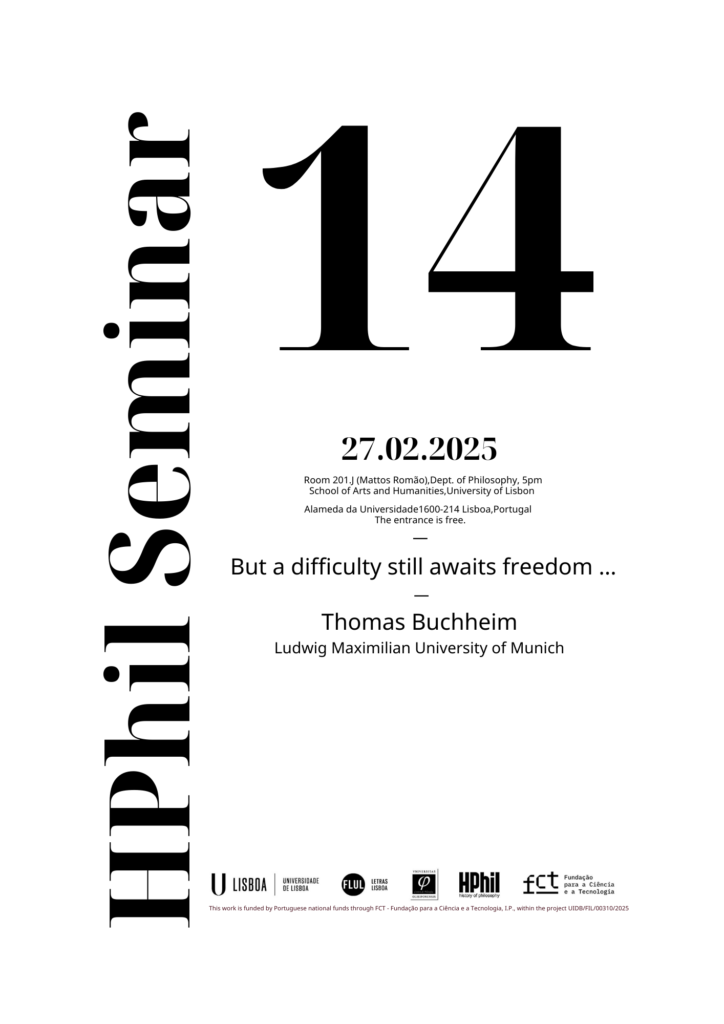
HPhil Seminar: February 27, 2025
27 FEB '25 | 17:00
The HPhil (History of Philosophy) Research Group of the Centre of Philosophy of the University of Lisbon announces the 2024/25 edition of its permanent seminar on the history of philosophy, devoted to the presentation of conferences by renowned specialists while also creating opportunities to emerging scholars, aiming to promote advanced studies in groundbreaking debates and the permanent training of its academic community.
In this session of the seminar, Thomas Buchheim (Ludwig Maximilian University of Munich) will present a paper, entitled “But a difficulty still awaits freedom …” (abstract below)
The session will take place on February 27, 2025 at 5 p.m., in the Room C201.J (Room Mattos Romão, Department of Philosophy). Admission is free.
Abstract
In the ‘Critical Elucidation of the Analytic’ of the Critique of Practical Reason, Kant submits that even if one accepts the solution he proposes in order to bring human acts into compatibility with the mechanism of nature (based on the doctrine of transcendental ideality of time and space), a still more considerable difficulty threatens human freedom. By that, he means the remaining difficulty of how the existence of finite subjects of freedom could at all be possible while at the same time regarding the latter as the creations of an almighty Maker of the world. Since at least the Freedom Essay (1809), Schelling’s entire philosophical carrier can be said to engage with this problem. The present lecture explores that problem in detail and reviews several of Schelling’s attempts to give it a consistent solution that does not disempower human freedom by reducing it to an epiphenomenon or merely apparent twitch in the fatalistic unfolding of a divinely preordained history of the world. The lecture will also show how, in Schelling’s own eyes, all those attempts remained unsatisfactory until his very last work, the Presentation of Purely Rational Philosophy (1854). In that work, Schelling finally took considerable steps to submit his philosophical approach to a deep revision. And as the lecture will conclude, even if until now that revision has remained largely overlooked by the standard interpretation of Schelling’s late philosophy, it is only in virtue of its crucial changes that Schelling finally came to a satisfactory solution of the problem outlined by Kant.
This work/event is funded by Portuguese national funds through FCT – Fundação para a Ciência e a Tecnologia, I.P., within the project UID/00310/2025, Centro de Filosofia da Universidade de Lisboa
(https://doi.org/10.54499/UID/00310/2025)