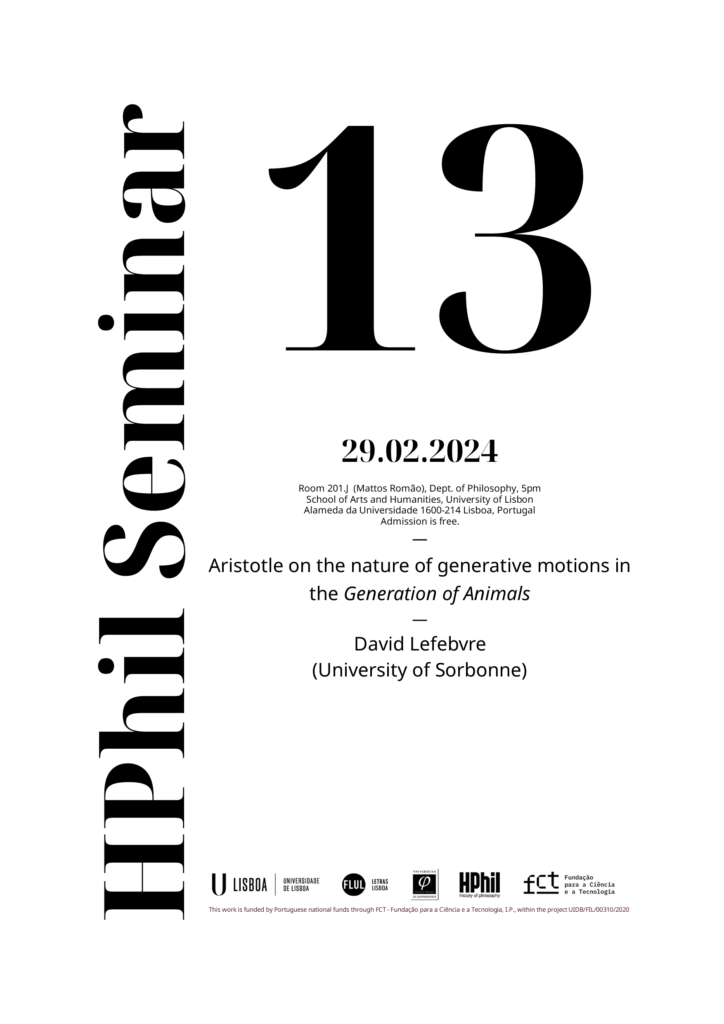
HPhil Seminar: February 29, 2024
The HPhil (History of Philosophy) Research Group of the Centre of Philosophy of the University of Lisbon announces the 2023/24 edition of its permanent seminar on the history of philosophy, devoted to the presentation of conferences by renowned specialists while also creating opportunities to emerging scholars, aiming to promote advanced studies in groundbreaking debates and the permanent training of its academic community.
In this session of the seminar, David Lefebvre (University of Sorbonne) will present a paper, entitled “Aristotle on the nature of generative motions in the Generation of Animals“, (abstract below)
The session will take place on February 29, 2024 at 5 p.m., in the Room C201.J (Room Mattos Romão, Department of Philosophy). Admission is free.
Abstract
Aristotle’s Generation of Animals has been the focus of a great deal of debate in the recent years. In particular, motion is an issue that has received special attention from scholars, which is to be expected since, from the very first lines of the treatise (GA, I 1, 715a13-15), Aristotle makes the “principle of motion” the main subject of the investigation that follows: it is the motion of the male’s seed, which carries a form, that is the cause of the generation of the heart and of the embryological development. In Aristotle’s explanations of this motion, a number of points remain obscure and are the subject of further research: for example, the relationship of this motion to the soul and to heat, described by Aristotle as “vital” or “psychic” heat, and the continuity of this motion between the genitor and the embryo. In this presentation, I will focus on the question of the very nature of this motion: from an ontological point of view, what kind of thing is generative motion itself, i.e. the motion that is at the principle of the formation of the heart and the parts of the embryo? Since Aristotle uses several analogies between this motion and the better-known case of macroscopic craft motions, how does the case of generative motion fit into the general Aristotelian theory of motion, and how can this theory clarify the status of these motions?